
(With editorial framing by BalangAI Strategic Security Institute)
Results First: What Recent Crises Revealed
Over the past two years, Western and Central Visayas have absorbed a succession of high-impact emergencies—major earthquakes, destructive typhoons, and prolonged volcanic unrest. Across these contingencies, one operational pattern became clear: reserve forces were not merely activated; they were organized, integrated, and employed alongside Regular Army units with minimal friction.
During the Cebu earthquake (September 2025) and the repeated eruptions of Mount Kanlaon, reservists augmented Regular Army formations in evacuation support, area security, and relief distribution. This was not simply “surge manpower.” It produced decisive operational effects. By employing the reserve component for territorial stability and civil-military interfaces, the 3rd Infantry Division (3ID) was able to preserve its Regular maneuver forces for higher-priority mission sets.
What stood out was not just availability, but integrated employment: clear tasking, predictable coordination with Local Government Units (LGUs), and continuity beyond the first 72 hours of response. These outcomes did not happen by chance. They were the result of a deliberate shift to align the reserve force with the 3ID’s campaign—well before the formal publication of a handbook.
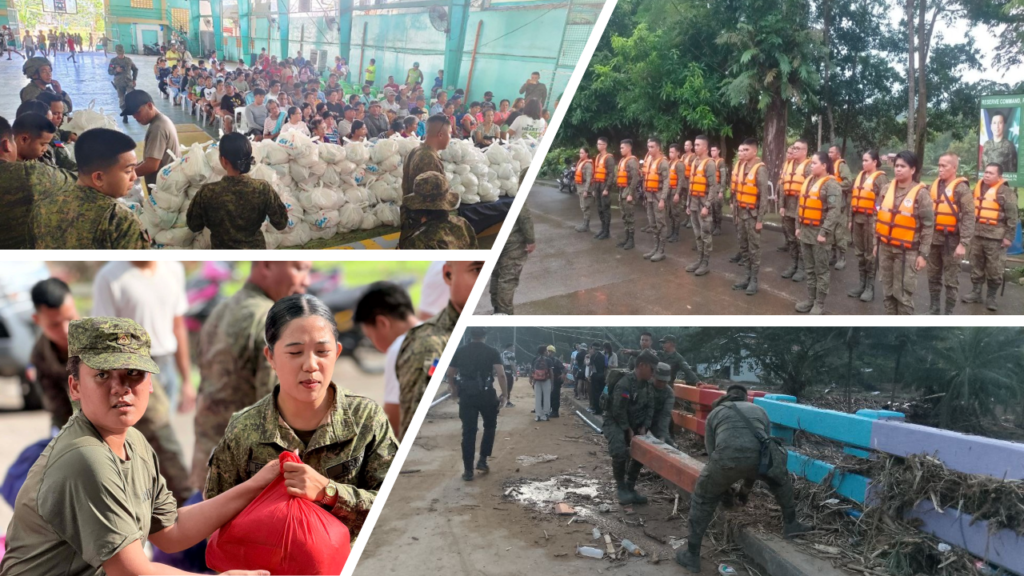
Photo Credit: 6RCDG and 7RCDG official Facebook pages, Philippine Army.
The Operational Gap: Development vs. Employment
To understand this evolution, it is necessary to distinguish between the force provider and the force employer.
The Reserve Command (RESCOM), through its Regional Community Defense Groups (RCDGs) and Community Defense Centers (CDCs), serves as the Army’s force provider. It is responsible for the Development, Organization, Training, Equipping, and Administration (DOTEA) of reservists.
The force employer, on the other hand, is the operational command—in this case, the 3rd Infantry Division / Joint Task Force Spear—responsible for applying those forces within a military campaign.
Historically, the bridge between provider and employer was narrow. While a pool of willing and trained reservists existed, there was no standardized framework for their operational employment. The solution was not to wait for a national policy revision, but to issue command directives that treated reservists as campaign enablers rather than administrative afterthoughts.
This effort was undertaken with the full support of the Division Commander, Maj. Gen. Michael G. Samson, ensuring that reserve force alignment with the campaign was treated as a command priority rather than a staff-driven initiative.
The 3ID Handbook: Codifying the “Total Force”
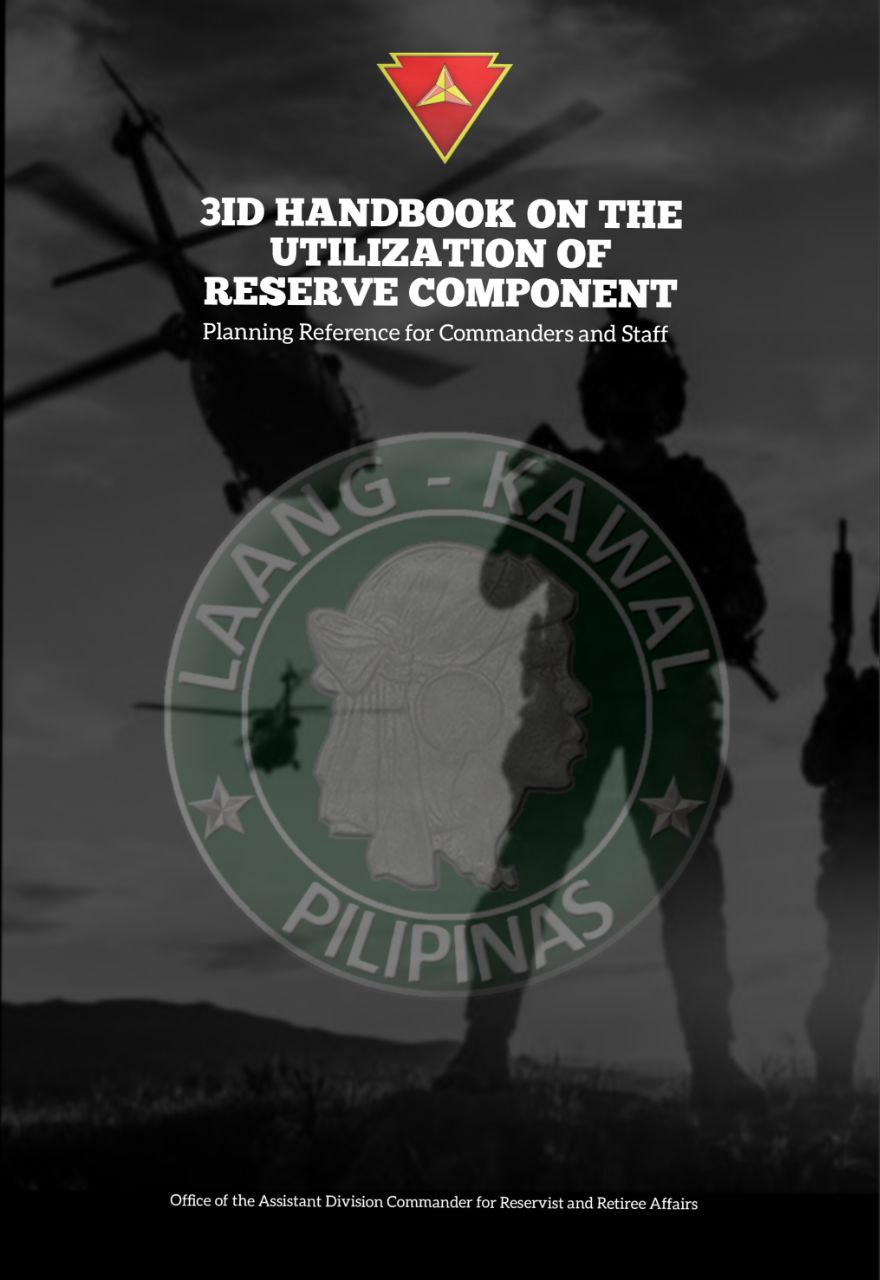
In November 2024, the 3rd Infantry Division published the Handbook on the Utilization of the Reserve Component—the first handbook of its kind at the division level in the Philippine Army.
The handbook did not invent a new concept. Instead, it codified an operational reality that had already been practiced, refined, and validated through real contingencies since 2022.
Consistent with Republic Act 7077 (AFP Reservists Act), the handbook shifts the focus from reserves as event-driven disaster manpower to reserves as a source of territorial depth and campaign continuity. It provides clear guidance on how reserve forces should be organized, trained, and employed to meet the actual requirements of Joint Task Force operations.
This followed a proven military sequence:
Operational practice → Refinement through command directives → Codification in doctrine
By formalizing what had already worked, the handbook transformed campaign experience into institutional memory—making it transferable, repeatable, and resilient beyond individual assignments.
Why This Matters for the Comprehensive Archipelagic Defense Concept (CADC)
The Armed Forces of the Philippines’ transition toward the Comprehensive Archipelagic Defense Concept (CADC) requires a distributed defense posture. In island-rich regions like the Visayas, Regular Army units cannot be everywhere at once.
As the 3ID shifts its focus toward external defense and maritime security, the reserve force becomes the anchor of territorial defense. Reservists serve in their own provinces, understand local terrain and communities, and maintain established relationships with LGUs—critical factors in crisis response and competition below armed conflict.
By integrating reservists into the campaign plan, the 3ID achieves:
- Territorial Continuity – sustained presence in rear areas and population centers while Regular units maneuver toward maritime and forward defense tasks
- Strategic Depth – endurance for long-duration operations that active-duty forces alone cannot sustain
- Whole-of-Nation Synergy – a practical bridge between military operations and local governance
In this sense, reserve integration is not a supporting activity; it is a core enabler of CADC execution.
Implementation: The Human Element
Institutionalizing this framework requires more than a handbook; it requires a persistent operational link between the force provider and the force employer.
Within the 3rd Infantry Division, this linkage is maintained through established command mechanisms that guide the Regional Community Defense Groups (RCDGs) in aligning reserve force recruitment, training, and activities with Joint Task Force operational requirements. This ensures that reserve force development remains synchronized with campaign priorities and operational needs, including the identification of civilian skill sets—such as logistics, medical, communications, and cyber—that are operationally relevant at the division level.
Equally important is sustained engagement with LGUs. Because reservists are citizens in uniform, their effectiveness is closely tied to the understanding and support of governors and mayors. Continuous coordination ensures that when a crisis occurs, reserve integration is a recognized and practiced protocol, not an improvised response.
Conclusion
Recent contingencies in the Visayas demonstrate that the Total Force is no longer a theoretical aspiration; it is an operational necessity.
The 3ID experience shows that when reserve forces are treated as a campaign function—rather than an emergency option—the division’s combat power is multiplied. The 3ID Handbook on the Utilization of the Reserve Component captures this evolution by providing commanders with a practical framework to organize, train, and employ reservists alongside Regular Army units.
In the 3rd Infantry Division, reserve integration has moved from ad hoc activation to campaign-aligned employment—making the Total Force real in both crisis response today and archipelagic defense tomorrow.
Author’s Note
Col. Lennon G. Babilonia (MNSA), PA, serves as Assistant Division Commander for Reservist and Retiree Affairs (ADCRRA), 3rd Infantry Division, Philippine Army. He led the development of the 3ID reserve employment framework beginning in 2022 and oversaw the publication of the 3ID Handbook on the Utilization of the Reserve Component in 2024. He is currently working on the further development of a community defense framework to strengthen the integration of reserve forces, local government units, and civilian stakeholders within the division’s campaign environment.
The views expressed are professional military assessments and do not represent official policy.
About BalangAI Strategic Security Institute
BalangAI Strategic Security Institute is an independent, non-partisan policy and research organization focused on peace, security, governance, and strategic issues affecting the Philippines, Southeast Asia, and the Indo-Pacific.
Contact
For inquiries, collaboration, or speaking engagements, please visit the
About BalangAI page or reach us through the website contact channels.