
BalangAI Editorial
We keep saying the Philippines is poor, weak, and dependent.
History says that excuse is lazy—and wrong.
The Balangay of Butuan proves that Filipinos were traders, governors, and outward-looking strategists long before the modern Philippine state existed. What changed was not geography—but mindset.
The Balangay is not proof of a glorious past for nostalgia’s sake. It directly challenges the myth that the Philippines was ever destined to be weak.
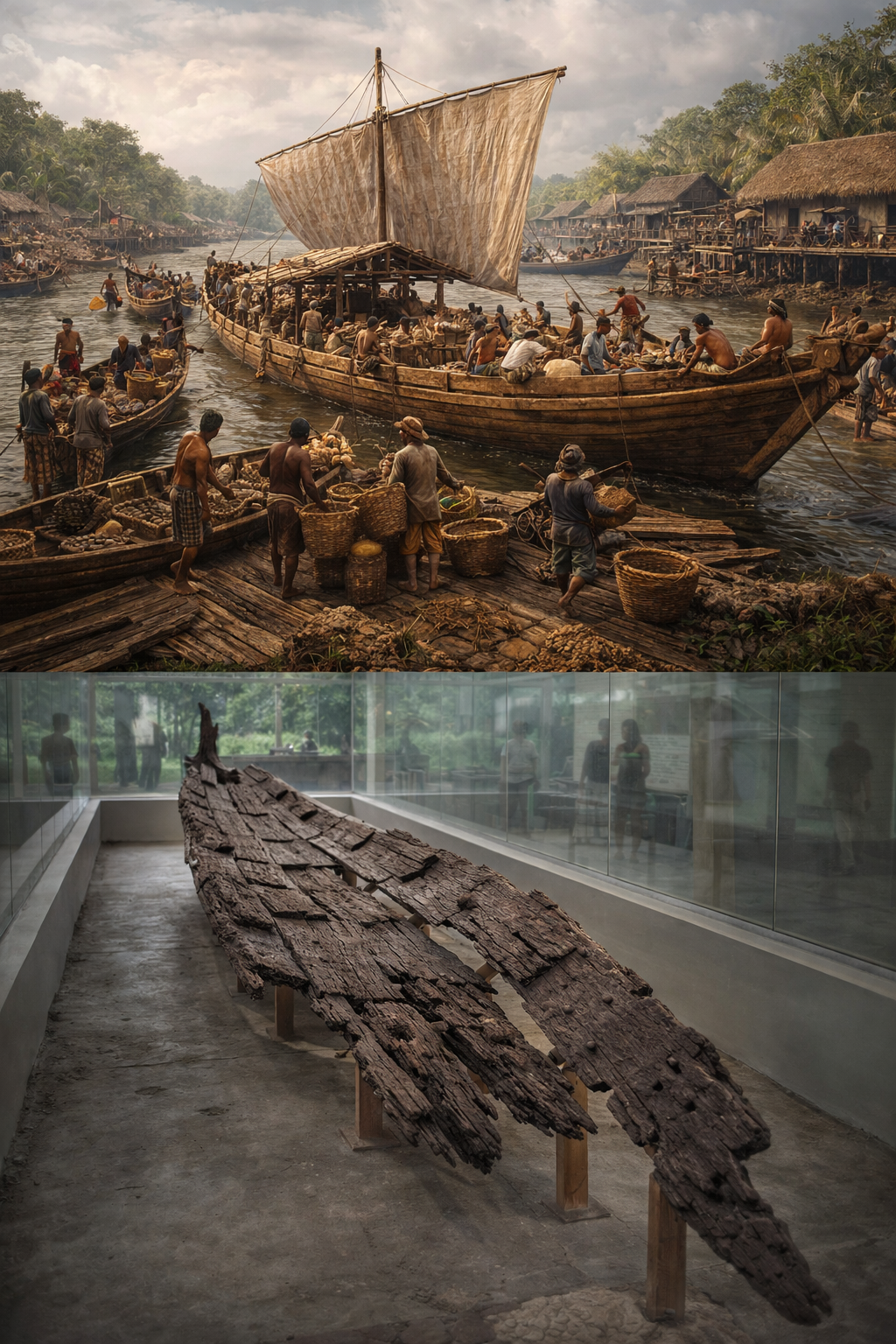
This is the distance between a working system and a remembered artifact.
Long before the Philippines existed as a republic, Butuan already functioned as an organized polity—often referred to by historians as the Rajahnate of Butuan—with recognized leadership, regulated trade, and diplomatic engagement with foreign powers. Chinese records from the Song Dynasty treated Butuan as a legitimate political authority, not a loose collection of merchants. China did not deal diplomatically with random traders. It dealt with recognized rulers.
That fact alone should unsettle us.
The Balangay boats discovered along the Agusan River were not fishing vessels. They were commercial platforms—built to move gold, goods, and people across regional trade routes. Gold ornaments and refined craftsmanship found in Butuan point to sustained wealth, control over production zones, and the ability to regulate exchange. Trade at this scale does not happen without rules, protection, and authority. In short, it does not happen without governance.
Even the word barangay exposes what we have forgotten. It originated from balangay—a community organized around a boat. That was not merely a social grouping. It was an economic and political unit: shared capital, shared risk, shared profit, under leadership capable of enforcing order and negotiating externally. This is how maritime trading societies function.
Order in the Philippines did not begin with colonization.
Trade in the Philippines did not begin with foreign tutelage.
Governance in the Philippines did not begin in 1898.
What colonization disrupted was not chaos—but an existing system.
Thinking Like a Landlocked State—Politically
Today, the Philippines is governed as if the sea does not matter.
This landlocked mindset does not stop at economics or strategy. It infects politics.
When leaders think inwardly, politics becomes local, short-term, and transactional. Power is treated as something to be extracted for personal survival and enrichment rather than exercised for national direction. Leaders focused only inward fail to see what is happening beyond their immediate political horizon.
A maritime nation that forgets the sea also forgets external threat.
While other countries think in terms of sea lanes, influence, encirclement, and long-term positioning, Philippine politics remains trapped in ward-level thinking—elections, favors, and self-preservation. Strategic warning signs around us are ignored, delayed, or minimized because they do not fit an inward-looking political imagination.
The failure to recognize threats around us is not just a military or diplomatic failure. It is a political one. Leaders who do not think outward cannot protect sovereignty outward.
Countries are rarely overrun because they are weak; they are overrun because they are unprepared—and unpreparedness begins in politics.
This is how countries lose ground—not always through invasion, but through strategic neglect.
The Real Warning of the Balangay
The Balangay is not a romantic artifact. It is a warning across centuries.
It tells us that Filipinos once built strength by:
- engaging outward
- trading strategically
- governing with awareness of external realities
Today, we do the opposite. We govern inwardly, react late, and excuse weakness as fate.
The Balangay now sits quietly in a museum, labeled as heritage. But it should make us uncomfortable. It proves that Filipinos once built institutions, networks, and power across water—without modern technology, without foreign instruction, and without excuses.
The Philippines did not become vulnerable because it is an archipelago.
It became vulnerable because its leaders stopped thinking like a maritime people.
The Balangay is not heritage.
It is an indictment.
And history will not be kind to a nation that once knew how to connect the world—then chose to look only at itself.
Recommended Further Reading
National Museum of the Philippines – Balangay Boats
Official archaeological documentation of the Butuan boats and related artifacts.
William Henry Scott, “Filipinos in China Before 1500”
Comprehensive research documenting Butuan’s diplomatic missions to Song Dynasty China (1001-1011 AD), based on Chinese imperial records. Published in Asian Studies, Vol. 21 (1983).
William Henry Scott, Barangay: Sixteenth-Century Philippine Culture and Society
Foundational work on precolonial Philippine social and political organization. Free to read online at Internet Archive.
Pierre-Yves Manguin, “The Southeast Asian Ship: An Historical Approach”
Academic research on indigenous Southeast Asian shipbuilding techniques, including the Butuan boats. [Open access PDF]
Maritime Review Philippines – Massive Balangay “Mother Boat” Unearthed in Butuan
Report on the discovery of a large Balangay vessel in Butuan, highlighting the scale, sophistication, and shipbuilding capability of precolonial Filipino maritime societies.
About BalangAI Strategic Security Institute
BalangAI Strategic Security Institute is an independent, non-partisan policy and research organization focused on peace, security, governance, and strategic issues affecting the Philippines, Southeast Asia, and the Indo-Pacific.
Contact
For inquiries, collaboration, or speaking engagements, please visit the
About BalangAI page or reach us through the website contact channels.