
Beyond the Reserves: Why the Philippines Needs National Mobilization
Executive Summary
When Filipinos hear “mobilization,” most think of reservists reporting for duty under RA 7077. That is one form of mobilization — but it is not the whole of national mobilization. Commonwealth Act No. 1 of 1935 already defined the larger concept: organizing the nation’s citizens and resources for national defense. The Philippines therefore does not lack the idea. The more important question is whether it has sufficiently developed, coordinated, and exercised the machinery needed to translate that idea into action across government, LGUs, critical civilian institutions, and the private sector. The disruptions experienced during the 2020 pandemic offer a useful warning of what happens when authorities and resources exist but coordination mechanisms must still be adapted under pressure. This article argues that the Philippines should consider a modern National Mobilization Act that clarifies, in peacetime, how the nation prepares to defend itself, continue functioning, and endure a major crisis.
Ask a Philippine military officer what “mobilization” means and the answer usually arrives without hesitation: calling up the reserves.
It is not a wrong answer. RA 7077, the Reservist Act, provides for the mobilization of the Reserve Force,1 and in many military conversations mobilization and reserve callup have become almost synonymous. Civilians can understandably inherit the same assumption — mobilization is something the Armed Forces does when it needs more soldiers.
Both understandings are true as far as they go, but neither captures the whole picture.
There is a much larger concept of mobilization that the Philippines defined for itself more than nine decades ago — one that is becoming increasingly relevant as the country confronts a more demanding external-security environment.
A Concept We Already Wrote Down — in 1935
Commonwealth Act No. 1, the National Defense Act of 1935, tied the country’s security to the employment of its citizens and its resources, not merely its soldiers.
Its language was direct:
The law went much further than a slogan. It directed the preparation of mobilization plans covering the country’s financial, industrial, economic, social, intellectual, and moral forces and resources. It required executive departments to prepare their respective parts of those plans before an emergency occurred. It also contemplated the use of public and private resources under lawful authority when national mobilization was ordered.2
Just as importantly, the law did not treat national defense as the responsibility of a single department. It created a Council of National Defense chaired by the President and composed of senior civilian and military officials.2
The important point is therefore not that the Philippines lacks national-security institutions. It is that the country’s foundational defense law already conceived mobilization itself as an interdepartmental national responsibility that had to be prepared in peacetime.
That is a strikingly broad conception for a law written in 1935 — broader, in some respects, than the way the word is commonly used today.
Over the decades, as the country’s security priorities shifted toward internal conflict and the Reserve Force developed under subsequent legislation, the everyday meaning of “mobilization” narrowed. What was originally conceived as the organization of national power increasingly became associated with the generation of military personnel.
That distinction is worth recovering.
Three Different Questions, Often Confused
It helps to separate three related but distinct forms of mobilization.
Reserve Force mobilization asks: Which reservists and reserve units must report for military duty?
Military mobilization asks: How does the country expand, organize, train, equip, and sustain the Armed Forces required by the situation?
National mobilization asks something much larger:
Modern joint doctrine recognizes essentially the same distinction. U.S. Joint Publication 4-05 describes mobilization in terms of organizing national resources and identifies requirements extending far beyond reserve personnel — including funding, civilian and military manpower, materiel, transportation, facilities, the industrial base, health services, and communications.3
Calling up the Reserve Force is therefore an essential part of mobilization, but it should not be mistaken for national mobilization itself. The former generates military manpower; the latter organizes the wider national capacity that allows those forces — and the state behind them — to operate and endure.
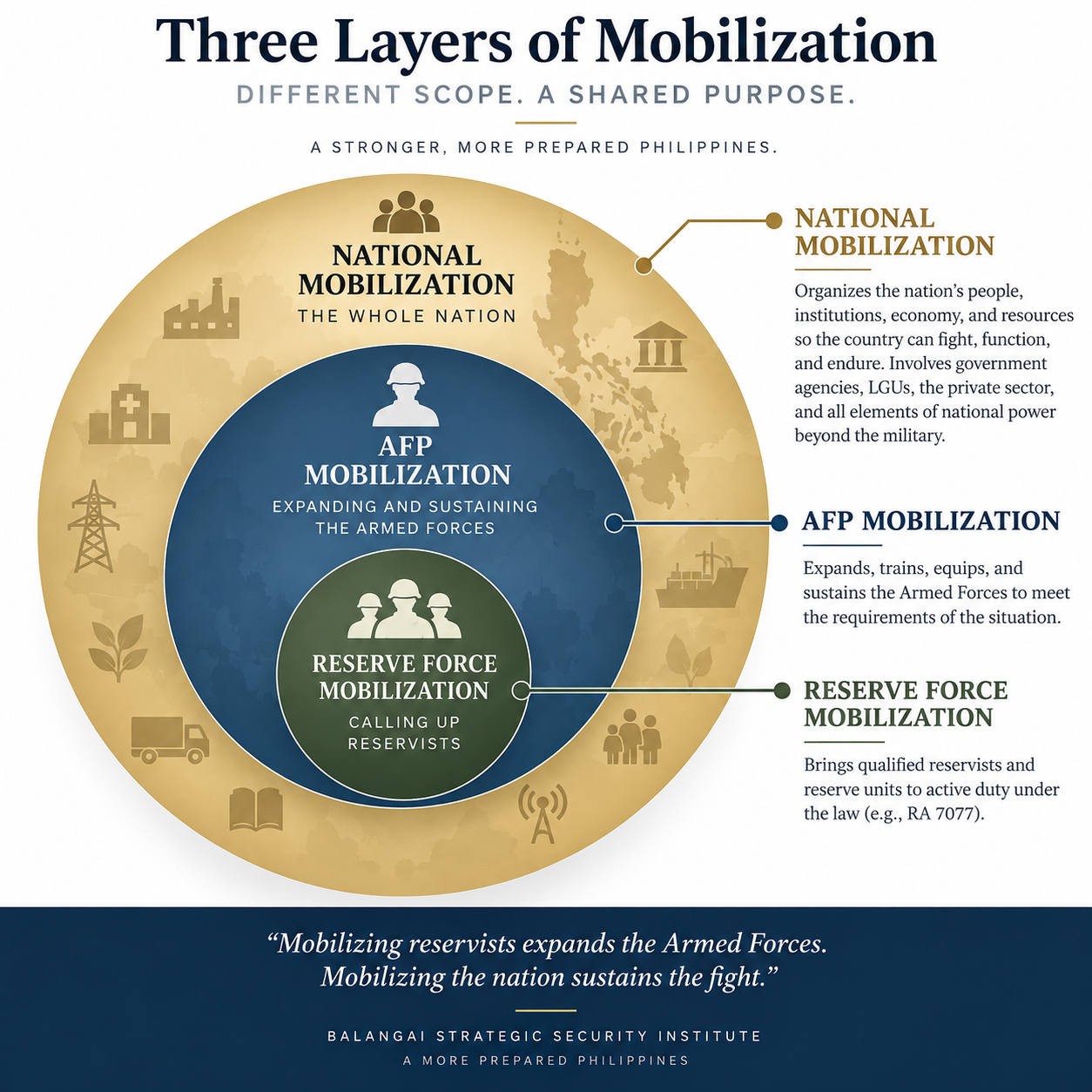
The relationship is easier to understand when viewed as layers rather than as three separate activities. Reserve Force mobilization sits at the center because it contributes personnel and units to the Armed Forces. AFP mobilization is broader: it organizes, expands, equips, and sustains the military capability required by the situation. National mobilization is broader still. It encompasses the Armed Forces, but also the civilian institutions, economic capacity, infrastructure, local governments, private sector, and population upon which both military operations and national continuity ultimately depend.
This layered view matters because it changes the question from simply how many reservists can be called to duty to whether the country as a whole is prepared to generate and sustain the capabilities required in a national emergency.
The Warning We Already Received
The Philippines does not have to imagine what happens when a national emergency cuts across the responsibilities of multiple agencies, levels of government, and civilian sectors.
It experienced a version of the problem in 2020.
COVID-19 was not a war, and pandemic response should not be equated with wartime mobilization. But it provides a useful national-scale stress test because it suddenly required government to regulate movement, sustain food distribution, protect health services, preserve economic activity, coordinate national and local authorities, and keep essential systems functioning simultaneously.
When the lockdown began, the country already possessed disaster-response, public-health, national-security, and emergency authorities. What proved difficult was translating these different authorities into consistently coordinated action across sectors and jurisdictions from the beginning.
Congress enacted successive special emergency measures — the Bayanihan to Heal As One Act in March 2020 and the Bayanihan to Recover As One Act several months later — as government adapted its response to the evolving crisis.4
The logistics experience is particularly instructive.
The problem was not merely theoretical. Reporting during the lockdown documented agricultural products failing to reach markets even while consumers elsewhere struggled with access to food. Farmers in the Cordillera were reported dumping unsold produce as movement restrictions disrupted distribution.9
The government responded. Food Lane Passes were issued, and the Inter-Agency Task Force subsequently approved RapidPassPH as a mechanism to improve the movement of authorized personnel and essential services. These responses deserve credit.
But the experience raises a larger preparedness question: why should mechanisms for moving critical personnel, food, and essential cargo have to be adapted and operationalized during the emergency itself rather than already being standardized, coordinated, and exercised beforehand?
This is the broader lesson for national mobilization. A country may possess substantial resources and even the legal authority to employ them, but neither automatically produces coordinated national capability. What turns resources into usable national power is an organized system that identifies requirements, assigns responsibilities, establishes authorities, coordinates institutions, and exercises those arrangements before they are needed.
The Government Must Mobilize the Nation — the AFP Cannot
This leads to a fundamental institutional distinction: the Armed Forces cannot mobilize the nation. Government must. The AFP can identify military requirements, determine the forces and capabilities necessary to accomplish assigned missions, and mobilize military forces under authorities provided by law. But it does not run the country’s commercial transportation system, telecommunications networks, power grid, food industry, hospitals, universities, financial institutions, or most of its industrial capacity — nor should it.
Many of the resources required to sustain national defense belong to civilian government, local government, private industry, professional institutions, and ordinary citizens.
The challenge is therefore not to place these institutions under military control, but to establish a framework through which their legitimate civilian functions can contribute to national endurance and, where necessary and lawful, support the requirements of national defense.
The distinction can be stated simply:
What a National Mobilization Act Should Actually Do
The first purpose of a modern National Mobilization Act should not necessarily be to create extraordinary powers after a crisis begins. Its more important contribution may be what happens before the crisis: making sure that every institution with a national responsibility understands what it is expected to prepare.
That responsibility will look different across sectors. Transportation authorities need to know how essential mobility can be preserved, while energy agencies must anticipate which services cannot be allowed to fail. Agriculture and industry need continuity arrangements for essential production and supply chains. Health authorities must be able to absorb extraordinary demands without abandoning civilian care, while public works and communications institutions need plans for maintaining and restoring critical infrastructure and connectivity. LGUs, for their part, need to understand how continuity of local government and essential services fit into the national effort. Critical private-sector institutions should likewise know where their capabilities may be needed before an emergency occurs.
None of this requires turning departments, businesses, universities, or communities into military organizations. It requires something much simpler:
Education Is Part of Mobilization, Not an Afterthought
A country cannot expect citizens suddenly to understand their responsibilities during a national crisis if those responsibilities were never part of their education.
National mobilization therefore begins partly in the classroom — not through militarizing education, but through developing informed citizenship.
Basic education can help young Filipinos understand patriotism, sovereignty, constitutional government, civic responsibility, national resilience, and the different ways citizens contribute when the country faces a serious emergency.
The objective is not to teach every child to become a soldier. It is to develop citizens who understand that national defense is not something performed somewhere else by someone wearing a uniform, but a national responsibility in which different citizens contribute in different ways.
At the tertiary level, Republic Act No. 9163 already provides a bridge between citizenship and preparedness. The National Service Training Program was established to enhance civic consciousness and defense preparedness among the youth through its different components, including military training, literacy, and civic welfare service.10
A modern national-mobilization framework should therefore examine how DepEd, CHED, DND, LGUs, educational institutions, and other stakeholders can connect citizenship education, national service, civic responsibility, and national preparedness into a coherent progression — while preserving the fundamentally civilian character of education.
The purpose is not to militarize young Filipinos, but to ensure that they understand why the nation matters, what citizenship requires, and how they may contribute when the country needs them.
A Lesson We Already Learned, Applied to a Different Problem
The Philippines has organized whole-of-government structures around national-security problems before.
One familiar example is the National Task Force to End Local Communist Armed Conflict under Executive Order No. 70.11
The comparison must be made carefully. A National Mobilization System should not inherit NTF-ELCAC’s counterinsurgency mission, its specific organization, or the political debates surrounding it; this article takes no position on its overall record. The relevant point is narrower and institutional.
But whatever one’s assessment of NTF-ELCAC, one institutional lesson is difficult to dispute:
National-security problems that exceed the competence of any single department require government to organize multiple institutions around a common objective.
Each agency can retain its civilian character, authorities, and expertise while contributing to a larger national effort. National mobilization requires the same basic organizing principle, applied to an entirely different mission — external defense and national endurance. Just as the country learned that internal-security challenges could not be addressed by the military alone, it must recognize that external defense cannot be accomplished by the Armed Forces alone. That is the institutional lesson worth carrying forward.
A Useful Comparison: Singapore’s Total Defence
Singapore offers a useful comparison, not because its geography, political system, resources, or threat environment are identical to those of the Philippines, but because it demonstrates what a continuously developed whole-of-nation preparedness concept can look like.
Philippines — Multiple Existing Systems
The Philippines already possesses national-security, national-defense, disaster-response, public-health, local-government, and emergency-management authorities. Major crises, however, can still require these different systems to be connected and adapted as events unfold. What is less visible is a single, publicly understood national-mobilization framework that connects defense requirements with pre-assigned responsibilities across government, LGUs, critical sectors, and citizens.
Singapore — Common National Framework
Singapore’s Total Defence concept has provided a common framework since 1984 and today organizes preparedness around six pillars: Military, Civil, Economic, Social, Psychological, and Digital Defence. The value is not simply the organizational structure. It gives government and society a common language for understanding how different sectors contribute to national resilience.12
Singapore’s model cannot simply be transplanted to the Philippines. It is a compact city-state with conscription and administrative, economic, and geographic conditions very different from ours. The useful comparison lies not in copying its structure, but in the underlying principle:
The Philippines therefore does not need to copy Singapore. It needs to develop a Philippine system suited to an archipelagic democracy — one grounded in its own constitutional order, local governments, economy, communities, and security environment.
A Requirements-Driven System, Not Another Bureaucracy
A National Mobilization Act should not simply instruct every agency to “support national defense.” That sounds authoritative but leaves the most important questions unanswered: support what, with what capability, under whose responsibility, and how do we know it will work when required?
National mobilization should instead be requirements-driven.
The defense establishment should identify the capabilities necessary to defend the country and sustain military operations. Government should then determine which requirements must be provided by the Armed Forces and which depend upon civilian departments, LGUs, public institutions, industry, or other sectors of society.
Those responsibilities can then be incorporated into plans, coordinated across institutions, periodically exercised, and reviewed.
The precise institutional arrangement — whether through an existing body, a strengthened mechanism, or a new national mobilization authority — deserves subsequent policy and legislative study.
That institutional debate should not obscure the more important principle: national requirements must be translated into institutional responsibilities, and those responsibilities must be understood and prepared before they are needed. The objective is not another council for its own sake. The objective is national readiness.
The Private Sector Is Part of National Power
This discussion cannot stop with government because much of the capability upon which modern societies depend is privately owned or operated. Telecommunications networks, shipping and trucking, warehouses, hospitals, manufacturing capacity, food and fuel distribution, engineering expertise, financial systems, construction equipment, and digital infrastructure all sit partly or largely outside government.
Government cannot simply assume that these capabilities will automatically be available in the right quantities, in the right places, and under the right authorities when a national emergency occurs. At the same time, private companies should not discover their potential responsibilities only after the crisis has begun.
A modern mobilization framework should therefore allow government and critical civilian sectors to establish appropriate arrangements during peacetime.
But national mobilization cannot simply mean government taking whatever it needs. Any modern law must contain safeguards: lawful authority, defined activation conditions, appropriate compensation, protection of legitimate civilian requirements, accountability, and respect for constitutional rights. The private sector should not be regarded merely as a warehouse of assets that government may requisition, but as a partner in national resilience whose own continuity also matters to the country.
LGUs Make National Mobilization Local
National mobilization also cannot be managed entirely from Manila. The Philippines is an archipelagic country whose people, infrastructure, industries, resources, and essential services are distributed across thousands of islands and hundreds of local governments. Whatever framework is designed at the national level must eventually work in provinces, cities, municipalities, and communities. In that sense, national mobilization inevitably becomes local.
Governors and mayors know their communities. LGUs already work with hospitals, schools, transport operators, businesses, utilities, volunteer organizations, and community institutions. They also possess extensive experience in disaster preparedness and emergency response.
A national mobilization framework should build upon those capabilities rather than unnecessarily duplicate them.
The national government can establish requirements and policy, while departments translate these into sector responsibilities and regional institutions coordinate where necessary. LGUs then need to understand what must be preserved, generated, or supported locally, with civilian institutions and communities participating according to their lawful roles. This is how national policy becomes actual national capacity.
Mobilization Must Begin Before Mobilization Is Declared
Perhaps the most important conceptual shift is this:
By the time a national emergency requires formal mobilization, much of the difficult work should already have been done. Government should know which capabilities are critical to national survival and defense. Departments should understand the responsibilities that fall within their mandates, while LGUs should know what must continue functioning locally and what support they may be required to provide. Critical industries should understand how they fit into the planning framework, legal arrangements should already be clear, and continuity plans should not have to be written for the first time while the country is under pressure.
Most importantly, these arrangements must have been exercised. A plan can appear complete on paper and still fail when confronted by real distances, competing authorities, disrupted communications, limited resources, or different interpretations at the local level. Exercises expose those gaps while there is still time to correct them.
The logic is simple:
Mobilization preparedness is therefore a continuing peacetime responsibility, while actual mobilization remains an exceptional act undertaken only when circumstances require it. That distinction matters because preparedness does not mean keeping the country permanently on a war footing. It means doing enough work in peace so that, when a serious crisis comes, government is implementing an established system rather than inventing one while the emergency is already unfolding.
Not a Nation Under Arms
Any serious proposal for national mobilization will raise legitimate concerns about militarization and extraordinary government authority, and those concerns deserve a direct answer. A National Mobilization Act should not place civilian institutions under military control, create a permanent war footing, or turn every citizen into a soldier.
Civil authority remains supreme — a principle explicitly embedded in the same 1935 National Defense Act that defined national mobilization.2
A modern framework should therefore contain clear activation authorities and thresholds, appropriate legislative oversight, protection of civil liberties and property rights, transparent mechanisms for compensation where private resources are lawfully committed to national use, accountability for extraordinary powers, and clear provisions for demobilization and recovery.
The purpose is not to militarize society. The purpose is to organize national capacity. A soldier may fight and a reservist may reinforce the Armed Forces, but national endurance also depends on teachers who continue educating citizens, doctors and nurses who preserve the health system, farmers who sustain food production, engineers who restore infrastructure, transport workers who keep essential supplies moving, and telecommunications personnel who keep the country connected. Business owners may have to preserve critical production and employment, while mayors and local officials keep government and essential services functioning in their communities. Young Filipinos may contribute through military, civic, literacy, professional, or other forms of national service.
The roles are different, but they form part of the same national effort.
Mobilizing the Nation
Debates about national defense tend to begin with ships, aircraft, missiles, military units, and alliances. Those things matter, but behind every fighting force is a nation that supplies it, transports it, finances it, communicates with it, treats its wounded, replaces what is lost, maintains its infrastructure, feeds its population, keeps government functioning, and preserves the will to continue. That wider capacity is national power, and organizing it for a national emergency is national mobilization.
The experience of 2020 demonstrated a narrower but important lesson. Even when legal authorities exist and resources are available, poorly coordinated implementation can compound a crisis. Food Lane Passes existed, yet some trucks were still delayed. Government adapted and developed additional mechanisms, but it had to do so while already responding to the emergency.
National mobilization asks whether more of that difficult coordination can be accomplished beforehand. The Philippines therefore does not need an entirely new idea; Commonwealth Act No. 1 gave the country the essential idea in 1935. The question for the present generation is whether that principle now requires a modern legal and institutional framework appropriate to a 21st-century economy, an archipelagic state, a democratic society, and a changing security environment.
The question should no longer be simply:
It should also be:
Mobilizing reservists expands the Armed Forces. Mobilizing the nation sustains the fight. And perhaps the most important conceptual change is this:
That difference is more than semantics. It changes how a country prepares for war and how responsibilities are understood long before one begins. By demonstrating that the country has organized itself to endure a major crisis, it may also strengthen deterrence and reduce the likelihood that such preparedness will ever have to be tested in war.
- Republic Act No. 7077, Citizen Armed Forces of the Philippines Reservist Act, 1991.
- Commonwealth Act No. 1, National Defense Act, 1935, particularly its provisions on national mobilization, mobilization planning, civil supremacy, and the Council of National Defense.
- U.S. Joint Chiefs of Staff, Joint Publication 4-05: Joint Mobilization Planning.
- Republic Act No. 11469, Bayanihan to Heal As One Act, March 2020; and Republic Act No. 11494, Bayanihan to Recover As One Act, September 2020.
- Australian Centre for International Agricultural Research (ACIAR), COVID-19 and Food Systems in the Philippines, citing a National Economic and Development Authority survey on checkpoint delays despite required documentation.
- Ibid., citing Department of Agriculture data on Food Lane Passes issued for Luzon as of April 2, 2020.
- Philippine Statistics Authority, revised national accounts for 2020. The initially reported 9.5 percent contraction was subsequently revised to 9.6 percent.
- Social Weather Stations, May 2020 survey on involuntary hunger, as reported in contemporary public reporting.
- Contemporary reporting on agricultural distribution disruptions during the enhanced community quarantine, including unsold produce in the Cordillera; see also ACIAR, COVID-19 and Food Systems in the Philippines.
- Republic Act No. 9163, National Service Training Program Act of 2001.
- Executive Order No. 70, s. 2018, institutionalizing a whole-of-nation approach and creating the National Task Force to End Local Communist Armed Conflict.
- Singapore Ministry of Defence and related official Total Defence resources. Singapore introduced Total Defence in 1984; the framework currently comprises Military, Civil, Economic, Social, Psychological, and Digital Defence.
About BalangAI Strategic Security Institute
BalangAI Strategic Security Institute is an independent, non-partisan policy and research organization focused on peace, security, governance, and strategic issues affecting the Philippines, Southeast Asia, and the Indo-Pacific.
Contact
For inquiries, collaboration, or speaking engagements, please visit the
About BalangAI page or reach us through the website contact channels.