
How preparedness, interoperability, and controlled transparency help reduce miscalculation in international security
Strategic Takeaway:
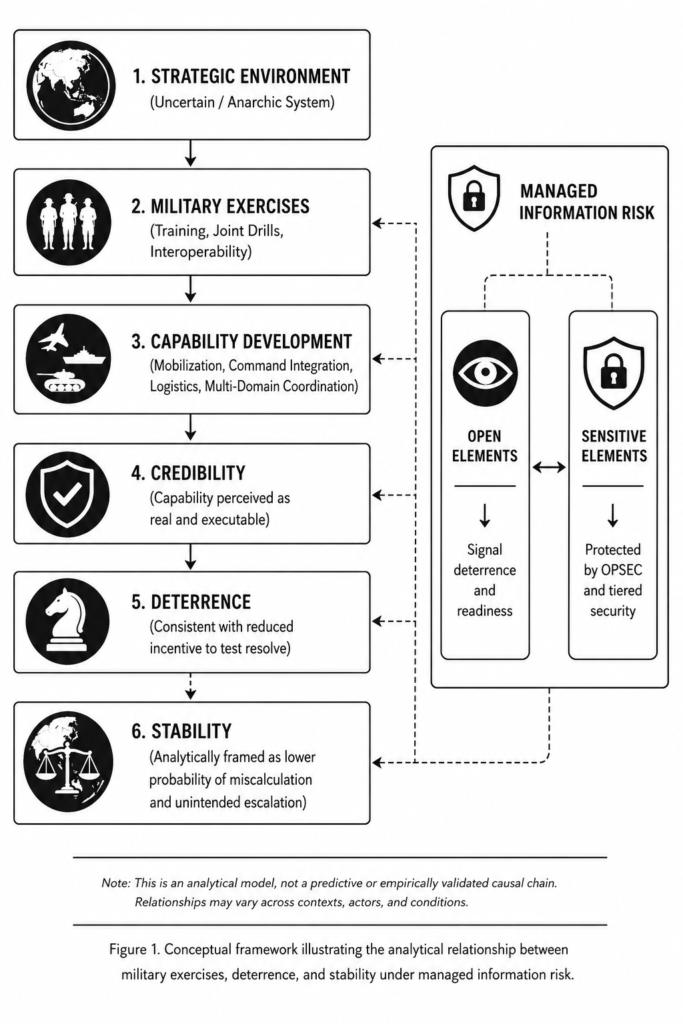
Military exercises function as strategic instruments that translate doctrine into credible capability, operate within deterrence logic, and help reduce the risk of miscalculation in an uncertain international system. When deliberately designed, they balance the need to demonstrate capability with the need to protect operational security.
Executive Summary
In an anarchic international system where no authority guarantees state survival, military exercises represent a rational response to uncertainty. They demonstrate credible capability in line with deterrence logic, support interoperability that makes alliance commitments more executable in practice, and surface institutional learning before crisis conditions emerge.
A serious counterargument must be acknowledged: exercises expose information in ways that external actors may attempt to exploit. The issue is not whether exercises create risk, but how that risk is managed. This article contends that the benefits can outweigh the risks when exercises are designed to signal strategic credibility while limiting operational detail. Preparedness, when structured within disciplined frameworks, supports stability rather than escalation.
Introduction
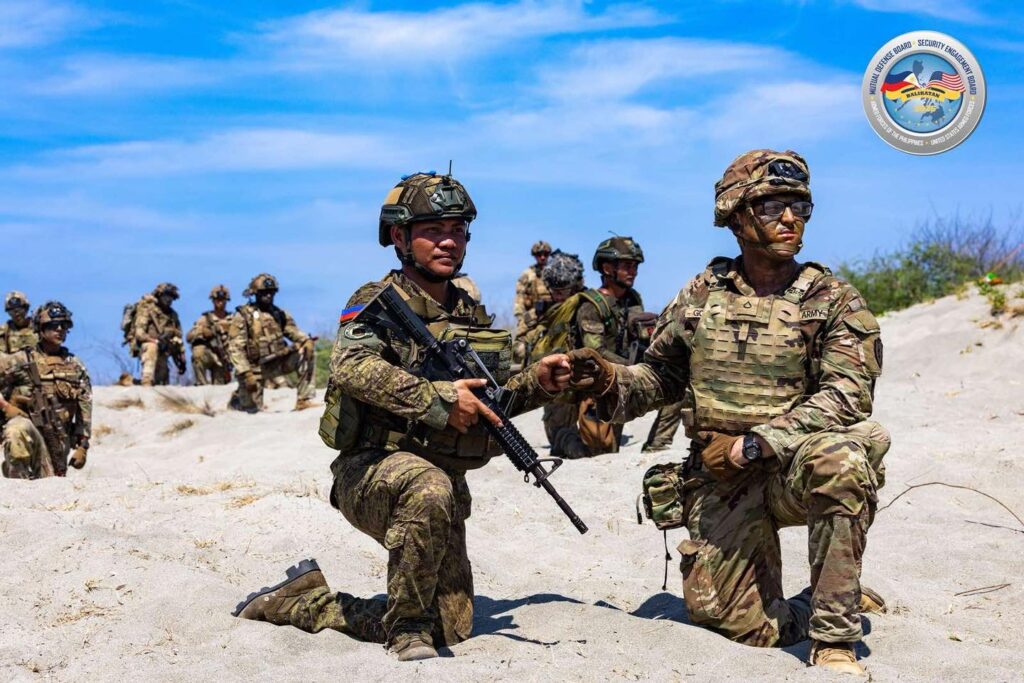
In periods of relative calm, military exercises can appear unnecessary or even provocative. Troops maneuver across unfamiliar terrain, aircraft operate in coordinated formations, and naval vessels conduct drills in contested environments. To outside observers, such activity may resemble outward-facing demonstrations of force.
For practitioners, however, exercises serve as structured rehearsals for uncertainty. Their value lies less in visible maneuver and more in the coordination beneath it—communications tested under pressure, command relationships clarified through repetition, and logistics systems stressed against realistic timelines. Friction is deliberately surfaced in training so it is less likely to emerge unexpectedly during crisis.
This visibility creates a strategic tension. Exercises reveal information, including patterns of coordination and readiness. The question is not whether exposure occurs, but how it is managed. Exercises remain strategically valuable when designed with full awareness of the intelligence environment in which they take place.
The Structural Logic of Preparedness
International relations theory helps explain why states conduct military exercises. Realist perspectives describe an anarchic system in which states operate in a self-help environment and must rely on capabilities they can generate and sustain. In this context, preparedness is a rational response to uncertainty rather than an inherently aggressive act.
Other approaches reinforce this view. Institutional perspectives suggest that transparency mechanisms can reduce uncertainty when backed by credible capability. Constructivist views emphasize that professional norms and organizational competence are built through repetition and institutional learning. These are best treated as analytical lenses rather than empirical proof, but they clarify why exercises remain central to state behavior.
A strategy that has not been exercised remains intention. Intention, without demonstration, carries limited deterrent weight.
The Security Dilemma and the Limits of Transparency
A persistent challenge in international security is the security dilemma: measures taken by one state to improve its security may be interpreted by others as threatening, prompting responses that intensify competition. This dynamic is especially visible in contested environments where military activity is closely observed and filtered through existing assumptions.
Military exercises sit in an ambiguous position within this dynamic. Under some conditions, repeated and structured activities can improve legibility. A force that trains consistently becomes more predictable in its procedures, which may reduce uncertainty about its behavior in crisis.
At the same time, transparency does not guarantee reassurance. Even routine exercises may be interpreted as signals of coercion or alliance consolidation. Visibility can amplify suspicion rather than reduce it, particularly where distrust or unresolved disputes shape interpretation.
The effects of exercises are therefore contingent. Outcomes depend on how activities are framed, the expectations surrounding them, and the broader strategic relationship between observing actors. Transparency operates as a conditional factor—stabilizing in some contexts, destabilizing in others.
The Information Risk and the Case for Intelligent Design
Exercises expose information, and that exposure carries risk. Observable activities may allow external actors to infer patterns of coordination, sequencing, and logistics. This much is not in dispute.
The policy question is how that exposure is managed. The key distinction lies between demonstrating strategic credibility and revealing operational specificity. Exercises can signal general capability—mobilization, interoperability, coordination—without disclosing sensitive procedures or decision thresholds.
Design is therefore central. Observable elements can be structured to communicate readiness and cohesion, while sensitive components remain restricted. Transparency and operational security are not opposites but design parameters that must be managed together.
Exercise design is a form of strategic tradecraft—the calibration of what to show, what to protect, and how to shape interpretation without surrendering advantage.
The alternative—untested capability—introduces a different kind of uncertainty, one that is harder to manage under crisis conditions.
The Philippine Case: Constitutional Grounding and Alliance Architecture
The Philippine context provides a clear legal and institutional basis for military exercises. The 1987 Constitution establishes civilian authority over the military and defines the Armed Forces as protector of the people and the State, placing preparedness within a framework of lawful and accountable governance.
Alliance arrangements, including the Mutual Defense Treaty and subsequent agreements, provide the structure within which joint exercises occur. These frameworks support interoperability, access, and long-term capability development.
Geography further shapes this logic. As an archipelagic state, the Philippines faces a dispersed security environment that requires coordination across maritime, air, and land domains. Preparedness therefore depends not only on capability, but on the ability to coordinate that capability across distance and time. Exercises rehearse these conditions, reinforce familiarity between forces, and support distributed response.
Repetition, in this context, reinforces credibility over time without implying guaranteed outcomes.
Deterrence, Institutional Learning, and the Cost of Neglect
Deterrence depends on credibility. Commitments that have not been exercised appear less certain, particularly under conditions of uncertainty. Exercises link declaratory commitments to demonstrated capability in ways consistent with deterrence logic.
They also generate institutional learning. Plans that appear coherent in planning environments often encounter friction in execution. Exercises allow organizations to identify gaps and adapt before crisis conditions arise, with learning accumulating over repeated cycles of execution and review.
The costs of sustaining such programs are real, including resource demands and signaling risks. At the same time, the costs of neglect may be higher. Forces that have not rehearsed coordination may respond more slowly, and untested systems may fail under stress. The balance depends on context, including threat environment and resource constraints.
Strategic Framework
This article presents military exercises within an analytical model linking preparedness, credibility, deterrence, and stability under conditions of managed information risk. The framework is illustrative rather than predictive.
Philippine Strategic Implication
For the Philippines, exercises form part of a broader readiness architecture shaped by geography, alliance commitments, and constitutional mandate. They strengthen coordination across domains and support preparedness under dispersed conditions.
Their role is best assessed at the level of capability preparation rather than performance outcomes. Sustained exercises, alongside modernization and institutional development, contribute to a posture aligned with both legal frameworks and strategic realities.
Conclusion
Preparedness is a form of responsible statecraft.
Military exercises translate doctrine into practiced capability, reinforce deterrence, and provide structured mechanisms for managing uncertainty. They also introduce risk, particularly through observable exposure. The policy challenge is not whether such risk exists, but how it is managed.
Rather than treating exercises as inherently stabilizing or destabilizing, it is more precise to view them as instruments whose effects depend on design, context, and interpretation. Under some conditions, they contribute to stability; under others, they may reinforce tension.
The issue is not whether exercises create risk, but whether that risk is deliberately managed or left to emerge under crisis conditions.
In the Philippine context, sustained and professionally designed exercises are best seen as foundational elements of defense policy. Preparedness, when disciplined and bounded, is not a departure from stability—it is one of its enabling conditions.
Notes
- Armed Forces of the Philippines, official releases on Balikatan and Salaknib exercises.
- 1987 Constitution of the Republic of the Philippines.
- Mutual Defense Treaty (1951).
- Enhanced Defense Cooperation Agreement (2014).
- AFP Modernization Program.
- Kenneth Waltz, Theory of International Politics.
- Thomas Schelling, Arms and Influence.
- Robert Jervis, “Cooperation Under the Security Dilemma.”
- John Mearsheimer, The Tragedy of Great Power Politics.
- Robert Keohane, After Hegemony.
About BalangAI Strategic Security Institute
BalangAI Strategic Security Institute is an independent, non-partisan policy and research organization focused on peace, security, governance, and strategic issues affecting the Philippines, Southeast Asia, and the Indo-Pacific.
Contact
For inquiries, collaboration, or speaking engagements, please visit the
About BalangAI page or reach us through the website contact channels.