
A Transformation That Starts in Training
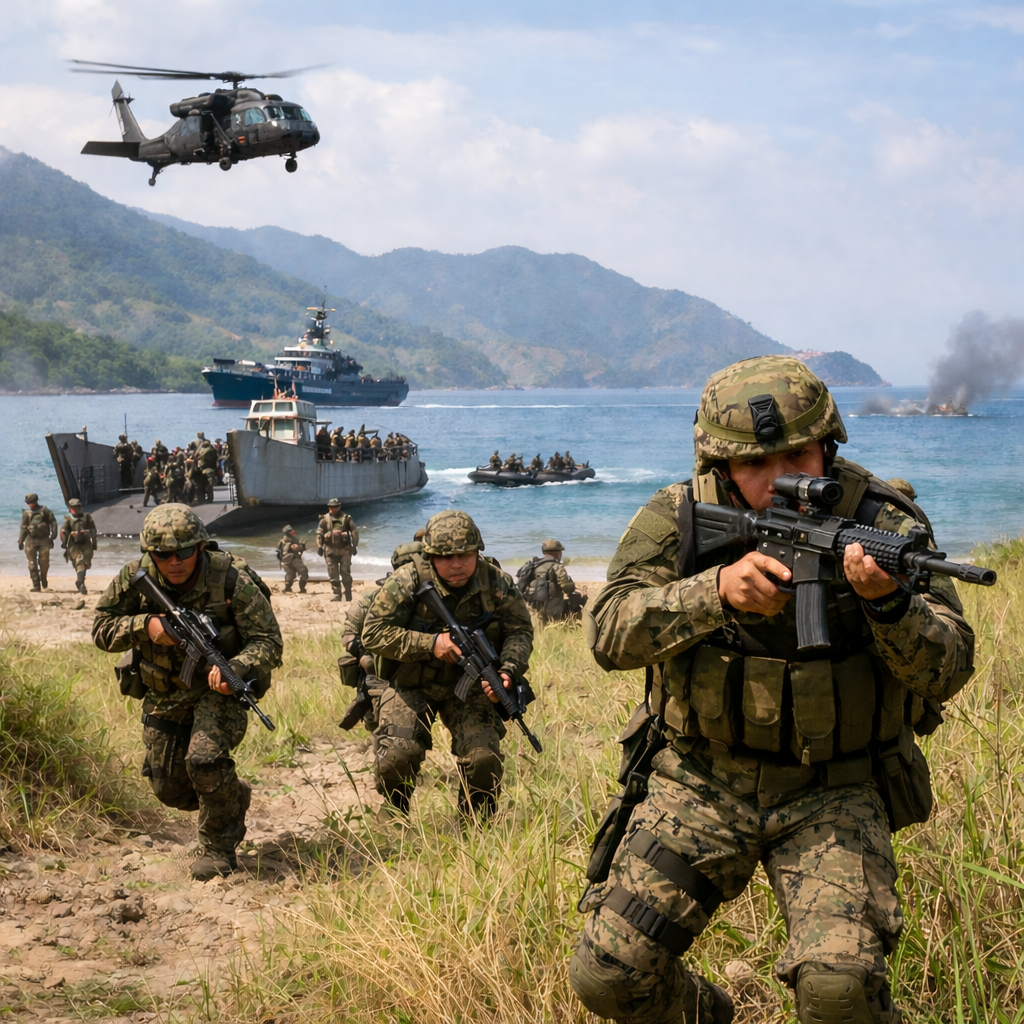
The Philippine Army is in the middle of a historic transition. After decades focused primarily on Internal Security Operations (ISO), it is now aligning itself toward Territorial Defense Operations (TDO) under the Comprehensive Archipelagic Defense Concept (CADC).
This shift is not simply about new equipment or updated doctrine. It is about preparing the force for a different kind of challenge: defending an archipelago in a complex, multi-domain environment.
And that preparation begins with training.
No army wins the war it didn’t train for.
Building on Strength, Not Starting from Zero
The Army did not begin this transition from weakness.
Years of internal security operations produced strengths that remain relevant today: decentralized leadership, adaptable small units, endurance in difficult terrain, and close coordination with civilian communities.
These foundations are not being discarded. They are being expanded.
What is evolving is the set of assumptions behind training.
In the past, operational scenarios often assumed reliable communications, fixed defensive positions, predictable supply lines, and a focus on holding ground.
Today’s training increasingly reflects different realities:
- Communications may be disrupted or jammed
- Forces may operate across multiple islands simultaneously
- Supply routes may be contested
- The objective may be to deny, delay, or disrupt rather than simply hold territory
This evolution reflects a deliberate effort to align training with the demands of archipelagic defense.
Because what gets practiced becomes what gets executed under pressure.
Anchored in the Army Transformation Roadmap 2040
The Army’s modernization and training reforms are guided by the Army Transformation Roadmap (ATR) 2040, which envisions a “world-class, multi-mission ready, and cross-domain capable” ground force by 2040.12
ATR 2040 recognizes that contemporary defense operations unfold across five interconnected domains:
- Land
- Maritime
- Air
- Space
- Cyberspace
These domains are interdependent. Satellite surveillance influences ground movement. Air and missile defense affects maneuver decisions. Maritime operations shape coastal security. Cyber threats target communications and logistics. Information campaigns influence public confidence and operational legitimacy.
Multi-Domain Operations does not mean the Army replaces other services. It means land forces train to function effectively within a joint system—contributing to national defense alongside the Navy and Air Force in a coordinated and integrated manner.
Modernization programs and strategic roadmaps provide direction. But they do not automatically produce capability.
They must be internalized through training.
Training is where strategic vision becomes operational reality.
Training in Action: Balikatan and Salaknib
Recent exercises demonstrate how this transformation is unfolding.
Exercise Balikatan 40-2025, according to the Armed Forces of the Philippines, emphasized Combined Joint All-Domain Operations (CJADO), integrating land, maritime, and air components under increasingly realistic and contested assumptions.3
Integrated Air and Missile Defense exchanges and maritime strike activities highlighted how land-based units now operate as part of a broader joint defense system.45
Complementing Balikatan, Exercise Salaknib 2025—a Philippine Army–U.S. Army bilateral exercise—focused on enhancing territorial defense readiness, interoperability, and multi-domain coordination at the land-force level.6 Salaknib activities include combined training events that strengthen command post operations, maneuver coordination, and joint planning processes tailored to Philippine operational conditions.
These exercises are not symbolic demonstrations. They are rehearsals for the type of coordination and adaptability required in archipelagic defense.
More importantly, the lessons from these exercises are increasingly fed back into training institutions—informing curricula, refining certification standards, and shaping professional military education.
The goal is simple: ensure that multi-domain integration becomes standard practice, not a special-event experience.
Repetition in training creates reflexes in operations.
The Growing Role of the Reserve Force
Archipelagic defense requires sustained presence across wide geography.
The regular force alone cannot maintain coverage everywhere.
With reserve forces comprising a substantial portion of the Army’s overall strength, their operational integration is no longer supplementary—it is structural.
Reserve forces provide:
- Territorial depth across dispersed islands
- Infrastructure protection for ports, airfields, and key facilities
- Reinforcement capacity during sustained operations
- Civil-military continuity during crises
- Specialized civilian-acquired skills in technical, cyber, and infrastructure sectors
Training reforms increasingly emphasize earlier integration of reserves in planning cycles, inclusion in certification exercises, improved mobilization understanding among regular commanders, and shared professional education frameworks.
When this integration matures fully, the Total Force concept becomes operational reality—not merely administrative design.
And that integration is built through training.
Why Training Institutions Matter
Training institutions quietly determine the future character of the force.
They shape:
- What young soldiers learn from the start
- How officers conceptualize operational problems
- What units must demonstrate to be considered ready
- Which assumptions become habitual
When curricula reflect multi-domain realities, those realities become normal.
When certification standards test joint integration and reserve interoperability, units prepare accordingly.
When professional military education embeds archipelagic defense logic, future commanders internalize it.
In this way, transformation spreads system-wide—not only through high-profile exercises, but through everyday instruction and evaluation.
From Vision to Capability
Modern defense is technologically complex. It involves coordination across land, sea, air, space, and cyberspace.
But its foundation remains human and institutional.
Equipment can be purchased. Concepts can be written. Strategic roadmaps can define ambition.
Only training turns those ambitions into reliable capability.
The Philippine Army’s transition toward archipelagic defense is therefore not merely a strategic shift. It is a training transformation.
Preparation happens daily—in classrooms, simulations, command post exercises, and field training across the country.
When crisis comes, the force that responds will not be the one described in policy documents.
It will be the one shaped by training.
Because soldiers do not fight the way planners imagine.
They fight the way they trained.
And no army wins the war it didn’t train for.
Notes
- Philippine Army, “Army Transformation Roadmap (ATR) 2040 – About,” official site.
- Philippine Information Agency, “Army sets 2040 Army Transformation Roadmap,” January 2023.
- Armed Forces of the Philippines, “PH-US Exercise Balikatan 40-2025 to Kick Off,” April 2025.
- Official release on Integrated Air and Missile Defense exchanges (Balikatan 2025), April 2025.
- Philippine News Agency report on Balikatan 2025 maritime strike and joint training activities, May 2025.
- Official release on Exercise Salaknib 2025, April–May 2025.
About BalangAI Strategic Security Institute
BalangAI Strategic Security Institute is an independent, non-partisan policy and research organization focused on peace, security, governance, and strategic issues affecting the Philippines, Southeast Asia, and the Indo-Pacific.
Contact
For inquiries, collaboration, or speaking engagements, please visit the
About BalangAI page or reach us through the website contact channels.