
Why the ROTC debate keeps repeating—and how completing NSTP as one system fixes the real problem
For over 20 years, the Philippines has debated the same question: should we mandate military training (ROTC) to instill discipline, or keep it optional to prevent abuse?
The argument returns whenever social disorder becomes visible, or national security feels uncertain. And each time, we are pushed into a false choice—more militarization or no national service at all.
That framing misses the point entirely.
The real issue is structural: the National Service Training Program (NSTP), created by law over two decades ago, was never completed as an operational system. It became three disconnected school requirements rather than one national service engine with shared purpose, minimum standards, tracking, and post-graduation utilization.
The result is a national paradox: millions complete NSTP, yet the country struggles to mobilize national service manpower when it matters most—especially during disasters.
What NSTP Was Supposed to Be
Republic Act No. 9163 (NSTP Act of 2001) did not abolish national service. It reorganized it into three components:
- ROTC – Military reserve training for national defense
- CWTS – Civic welfare service, including community development and emergency-preparedness activities
- LTS – Literacy and teaching support programs
This structure reflected a basic security reality: modern national defense extends beyond armed combat. Republic Act No. 7077 (Citizen Armed Forces Reservist Act of 1991) already affirms that reservists serve not only in war or national emergency, but also to meet local emergencies arising from calamities, disasters, and threats to peace, order, security, and stability.
NSTP was designed to generate trained manpower across the whole spectrum—military and civilian capabilities working together—so the country would not rely only on improvisation and ad hoc volunteers during crises.
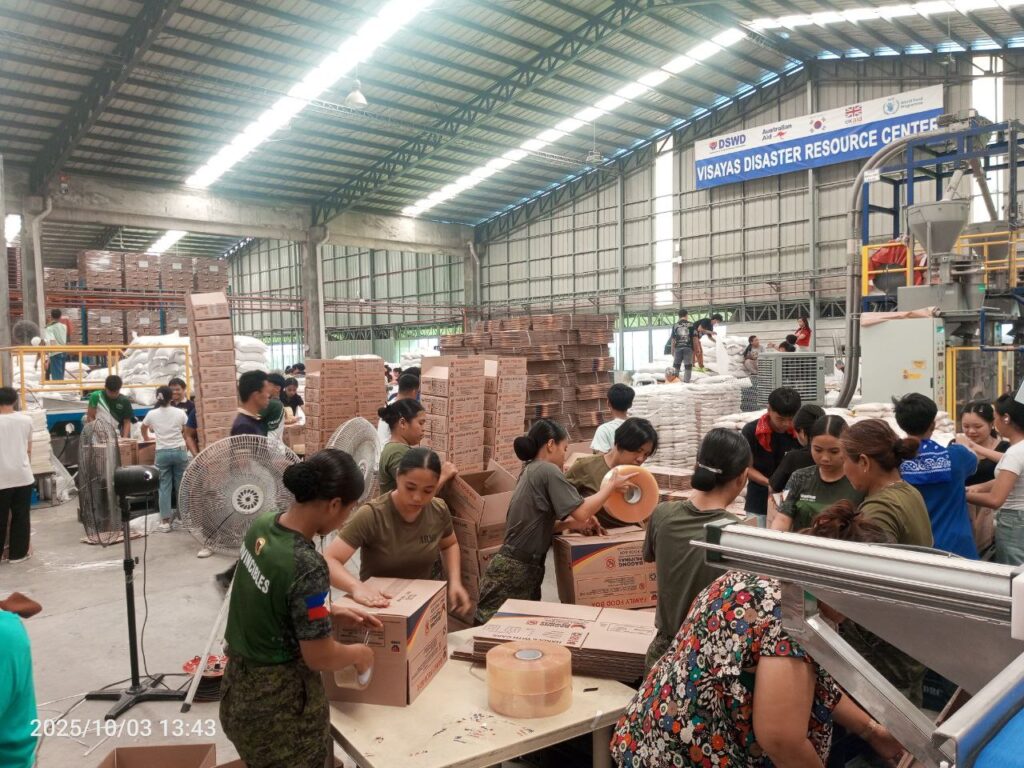
This type of work—logistics, warehousing, and distribution—is a critical component of disaster response and national resilience. While ROTC cadets are shown here, these functions are not exclusive to military training. They represent roles that all NSTP components—ROTC, CWTS, and LTS—are designed to support as part of a unified national service system.
The Real Choice (and Why the ROTC Debate Keeps Failing)
The decision facing the Philippines is not “mandatory ROTC” versus “abolish national service.”
The real choice is between keeping a fragmented system and finishing NSTP as one integrated national service system.
Option 1: Keep a fragmented system
- Students check boxes without purpose
- ROTC becomes the only visible and routinely utilized component
- CWTS/LTS remains largely academic compliance with uneven standards
- Graduates leave with little expectation of post-graduation utilization
- National service becomes a culture war instead of a national capability
Option 2: Build an integrated NSTP system
- NSTP is treated as one national service framework with shared purpose
- All three components meet minimum formation and emergency-readiness standards, adapted to different roles
- Each track has clear utilization pathways and a disciplined identity, not just classroom completion
- Graduates are tracked, organized, refreshed, and mobilized through existing DRRM structures
- ROTC is protected by professional standards and safeguards—so readiness is built without abuse
Different functions. One national mission.
The Numbers Everyone Cites (and the Monitoring Gap Everyone Ignores)
One set of national figures is often cited for the first decade of NSTP implementation (2002–2012), attributed to a CHED compilation that has circulated widely in policy and education discussions:
- CWTS: 10,614,000 graduates
- LTS: 538,700 graduates
- ROTC: 1,435,000 graduates
Taken together, CWTS and LTS produced roughly 11.15 million graduates—nearly eight times the ROTC total—yet public debate and institutional attention remain overwhelmingly ROTC-centric.
Whether one focuses on the precise totals or the overall direction, the central point remains: the civilian-track manpower base is massive. What is more telling—and harder to defend—is the lack of consistently published, consolidated national reporting after 2012 that the public can easily audit year after year. The absence of routine transparency reflects the deeper truth: NSTP was treated as a compliance program, not as a national capability program.
How Two Classes of Service Were Created
Over time, an unequal divide emerged—not because the law required it, but because implementation drifted.
ROTC became the visible, utilized component
ROTC cadets are routinely tapped for school and community events, civic assistance, and surge manpower during emergencies. In many local settings, disaster-response planners prefer ROTC-linked manpower because it can be organized, tasked, and supervised quickly.
ROTC’s advantage is not the uniform. It is the system around it: clearer oversight, standardization, repeated exposure to mobilization, and an institutional expectation that training will be used.
CWTS and LTS remained largely classroom-confined
CWTS and LTS can be implemented seriously. Some institutions build robust programs that include first aid, fire safety, rescue fundamentals, disaster-preparedness drills, and community risk-reduction projects. But these are still exceptions rather than the rule.
In many schools, CWTS/LTS requirements are completed through one-off community activities with little connection to sustained mobilization, DRRM tasking, or a post-graduation service identity. The practical outcome is predictable: ROTC students often expect to be called upon; CWTS/LTS students often finish and disappear.
The Ideological Vacuum Problem
When national service becomes mere compliance, students lose the sense that they belong to something meaningful. When institutions fail to provide disciplined pathways for contribution, a vacuum forms.
That vacuum becomes ideological. People—especially the young—seek identity, belonging, moral purpose, and a story that explains why their effort matters. If legitimate institutions offer only paperwork and token activities, other narratives and networks will compete to fill the space, sometimes with divisive or adversarial framings that weaken cohesion.
This is not an argument for paranoia. It is an argument for competence: the correct response is not blanket suspicion, but better formation, stronger institutions, and real service pathways that make national service credible and lived—not just completed.
Everyone Is Already a Reservist—On Paper
NSTP graduates do not simply “finish a subject.” By law, NSTP creates reservists across two linked but distinct pathways:
1) ROTC graduates: AFP reservists
ROTC is the military track. Upon completion, ROTC graduates enter the Armed Forces of the Philippines (AFP) reservist framework and are carried in the AFP reserve force system (commonly referred to in practice as reservist rosters managed through AFP reserve structures). This is why ROTC has a clearer chain of supervision, training standards, and operational linkage to uniformed missions.
2) CWTS and LTS graduates: NSRC reservists
CWTS and LTS graduates, on the other hand, belong to the National Service Reserve Corps (NSRC). The NSRC is the civilian-track reserve of trained service manpower meant for civic and emergency roles. Critically, the Philippine DRRM law (RA 10121) situates the NSRC for accreditation and mobilization in disaster risk reduction and related activities—linking it to the Office of Civil Defense (OCD) and to LGU DRRM councils and systems.
In plain terms: ROTC produces military reservists aligned to AFP structures; CWTS/LTS produces NSRC reservists intended for civilian surge support and DRRM mobilization through OCD-linked mechanisms. The legal bridge exists. What is missing is a functioning operational system that makes this bridge real.
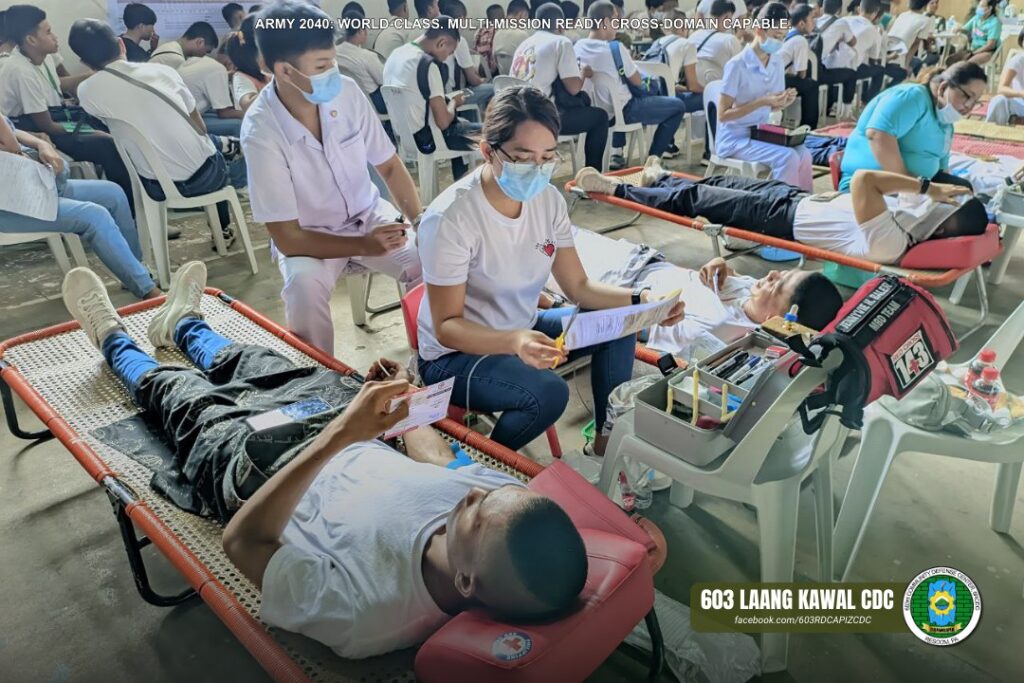
Discipline and Patriotism Aren’t ROTC-Exclusive
Advocates of mandatory ROTC often argue that only military training can instill discipline and patriotism. That confuses method with outcome.
Discipline comes from clear expectations, accountability, and meaningful work. Patriotism is reinforced when citizens understand how their service contributes to national resilience—especially during crisis.
ROTC can provide this when professionally implemented: repeated mobilization shows cadets that training is real, not theoretical. But a medic doing triage, an engineer supporting resilience work, or a teacher serving in literacy missions requires the same discipline and demonstrates the same patriotism. The difference is not the uniform; it is institutional seriousness and systematic deployment.
What Integration Requires (Completing the System)
Integration is not additional bureaucracy. It is completing the system that already exists and has already been paid for, using structures already in place.
Unified standards
All NSTP components should share baseline formation standards: civic discipline, accountability, national purpose, and basic emergency-readiness competencies (tailored to different roles). ROTC remains military; CWTS/LTS remains civilian. But all should share a common national-service identity and minimum competence for crisis support.
Equal institutional visibility
CWTS/LTS units should not be invisible. They should participate alongside ROTC in school events, community preparedness activities, and appropriate support roles—so service identity is reinforced through repeated, visible contribution.
Systematic post-graduation mobilization (OCD-administered NSRC pathways)
NSRC must have real call-up and deployment pathways administered by the Office of Civil Defense (OCD) and linked to LGU DRRM systems. This means functional rosters, skills classification (medical, teaching, engineering, logistics, communications, etc.), periodic refresher activities, and clear protocols for mobilizing graduates during emergencies through local DRRM councils and coordinating structures.
Visible utilization and reporting
A system that does not report cannot be corrected. Require routine public reporting (even in aggregate): how many are organized, refreshed, and mobilized, and what missions were supported. Transparency drives seriousness.
Institutional accountability
If ROTC is standardized and supervised, CWTS/LTS cannot be left to drift. Integration requires governance discipline—clear coordination among CHED/TESDA, LGUs, and OCD for NSRC pathways, and professional safeguards for ROTC so capability is built without abuse.
The Strategic Asset We’re Ignoring
The Philippines does not suffer from a lack of willing youth. It suffers from lack of system.
The CWTS/LTS manpower base is enormous, but much of it remains unorganized, unevenly standardized, and rarely mobilized after graduation. Meanwhile, ROTC units shoulder disproportionate community and disaster-response burden because they are the only component that regularly looks and functions like an organized capability.
You cannot mobilize what you never built. And you cannot keep calling NSTP “national service” if the country cannot consistently activate national service manpower when it needs it most.
Conclusion: Finishing What We Started
NSTP was designed to organize national service across all its necessary forms—soldiers, medical responders, teachers, engineers, communicators, and community organizers—each contributing according to their role.
The problem is not that NSTP failed. The problem is that it was never completed as a system.
Until NSTP is integrated—standards, identity, tracking, and mobilization—the ROTC debate will keep repeating, polarization will deepen, and the country will continue to waste its greatest strategic resource: its own people.
References
Legal Framework
- Republic Act No. 9163 (NSTP Act of 2001). Official Gazette of the Republic of the Philippines. Read full text →
Establishes the three-component NSTP structure (ROTC, CWTS, LTS) and creates the National Service Reserve Corps (Section 11). - Republic Act No. 7077 (Citizens Armed Forces of the Philippines Reservist Act, 1991). Read full text → | Alternative source →
Section 7 defines the mission of the Citizen Armed Force/Reserve Force: “to provide the base for the expansion of the Armed Forces of the Philippines in the event of war, invasion or rebellion; to assist in relief and rescue during disasters or calamities; to assist in socio-economic development.” - Republic Act No. 10121 (Philippine Disaster Risk Reduction and Management Act of 2010). Official Gazette. Read full text →
Section 13 mandates “accreditation, mobilization, and protection of disaster volunteers and National Service Reserve Corps” for disaster risk reduction programs. - CHED Memorandum Order No. 027, Series of 2015. Commission on Higher Education. Read guidelines →
Guidelines and Procedures on the Issuance of National Service Training Program (NSTP) Serial Numbers. Covers NSTP graduates from AY 2002-2003 to 2014-2015, confirming the scale of the program and registry system.
Data and Research
- NSTP Graduate Statistics (2002–2012): CWTS 10,614,000; LTS 538,700; ROTC 1,435,000 graduates.
These figures are widely cited in policy discussions and legislative hearings. While no single consolidated CHED report for this period is publicly accessible online, the statistics have been consistently referenced in:- Senate Committee on Education hearings on NSTP review (2019). Read news report →
- CHED CMO 027-15 covering serial number issuance for graduates 2002-2015
- Academic literature on NSTP assessment, including Victoria, E.L.M. (2017) “NSTP-CWTS of the Higher Education System: The Philippine Experience”
- Victoria, Edna Liza M. (2017). “NSTP-CWTS of the Higher Education System: The Philippine Experience.” JPAIR Institutional Research, Vol. 9 No. 9, pp. 48-68. Read article →
Study of 22 Higher Education Institutions in Central Luzon (643 CWTS students) documenting implementation practices. Found that “community activities were comprised largely of ecological-environmental initiatives like tree planting, lecture on climate change, proper solid waste management, and calamity-disaster preparedness” – confirming the pattern of one-time community activities rather than sustained disaster response integration. - University of the Philippines Diliman – NSTP Office. Visit website →
Institutional example of NSRC operations, including documented mobilization during Super Typhoon Carina (July 2024). Provides data on NSTP graduate induction into NSRC. - Philippine News Agency (2019). “ROTC plays significant role in times of disaster.” Read full article →
Interview with MDRRM Officer Albert Galan documenting local government reliance on ROTC units as “personnel component” for search and rescue during disasters.
Note on Data Sources
All legal citations (RA 9163, RA 7077, RA 10121) are verified through official government sources.
The NSTP graduate statistics (2002-2012) are widely cited in policy discussions and legislative hearings. While no single consolidated CHED report for this period is publicly accessible online, the figures have been consistently referenced across multiple official sources and are supported by CHED’s own memorandum orders covering this timeframe.
The absence of comprehensive national statistics beyond 2012 itself reflects the monitoring gap this article addresses.
About BalangAI Strategic Security Institute
BalangAI Strategic Security Institute is an independent, non-partisan policy and research organization focused on peace, security, governance, and strategic issues affecting the Philippines, Southeast Asia, and the Indo-Pacific.
Contact
For inquiries, collaboration, or speaking engagements, please visit the
About BalangAI page or reach us through the website contact channels.