
The paradox of success without closure
In Eastern Samar during the late 2010s, AFP operations systematically reduced NPA presence across multiple municipalities. Encounter rates dropped sharply over an 18-month period. By conventional military metrics, the area was secure.
Yet several years later, intelligence reports indicated that recruitment activities had resumed in previously-cleared municipalities. Underground organizing had reconstituted in barangays where sustained government presence had failed to materialize after the military departed the cleared area.
This pattern reveals a fundamental truth: winning the war is not the same as securing the peace.
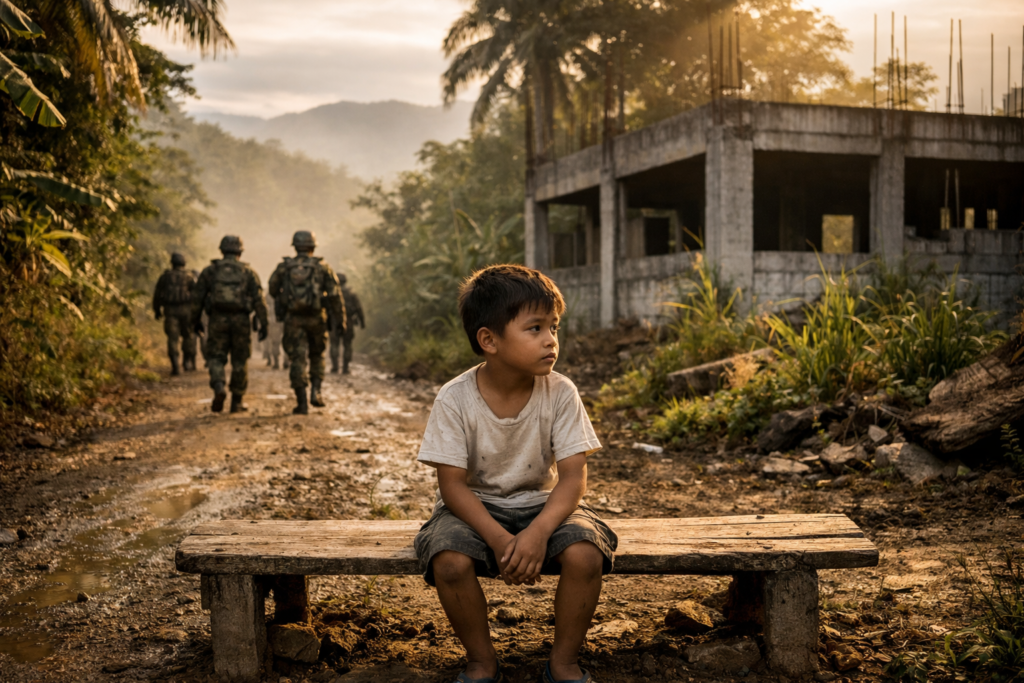
For over five decades, the Armed Forces of the Philippines has confronted one of Asia’s longest-running communist insurgencies. The New People’s Army has been reduced from a peak of over 20,000 fighters in the late 1980s to approximately 1,500 as of late 2023—a reduction of more than 90% (International Crisis Group, 2011; Carvajal, 2023).
Yet the insurgency persists. As former AFP Chief of Staff Gen. Emmanuel Bautista observed in 2011: “We have been fighting for too long. Too many have died… We have an obligation to really win the peace because we owe it to those who came before us” (Cabacungan, 2011).
If we’ve won the military campaign, why does the threat keep reconstituting?
The answer lies in the “last mile” problem—converting military success into political closure by dismantling the networks that sustain insurgency, establishing governance that communities trust, and delivering development that makes resistance pointless.
The two-dimensional nature of insurgency
Modern counterinsurgency doctrine emphasizes that insurgency operates on two interdependent dimensions requiring fundamentally different responses (Galula, 1964; Kilcullen, 2010; Central Intelligence Agency, 2012).
The armed component (“Red Area”): Armed fighters, tactical operations, coercion through violence, and physical control of terrain. This is military terrain where the AFP has demonstrated clear mastery, achieving over 90% reduction in insurgent armed strength.
The enabling environment (“White Area”): Recruitment networks, financial systems, underground logistics, propaganda, legal fronts, and exploitation of governance gaps. This requires law enforcement, financial regulation, social services, local governance, and economic development—capabilities that lie with civilian institutions.
The two are symbiotic. Armed groups draw sustenance from white area; white area relies on armed groups for coercion. Eliminate only the armed component, and the system can regenerate.
As Maj. Gen. Leonardo Peña’s analysis of Philippine counterinsurgency history concluded: “Despite current perceptions, counterinsurgency operations are not the exclusive domain of the military. In fact, the possibility of success is often diminished when the military takes a dominant role in counterinsurgency operations” (Peña, 2007, p. 2). Successful counterinsurgency requires collaborative interagency approaches where military forces create security conditions while civilian institutions address underlying political, economic, and social dimensions.
The operational pattern: clearing without holding
Field experience across multiple regions reveals a consistent four-phase pattern. While specific timelines vary by area and operational conditions, the following represents typical patterns observed across multiple clearing operations:
Phase 1: Military clearing succeeds (typically 6-18 months) AFP operations effectively neutralize NPA presence through intelligence-driven operations and sustained pressure. Immediate security improves dramatically.
Phase 2: Transition gap emerges (typically 6-24 months) Civilian agencies face deployment challenges—budget cycles misaligned with operational timelines, safety assessments lagging security improvements, geographic isolation increasing costs, and personnel resisting remote assignments. The AFP fills gaps through civic action programs, but this is temporary.
Phase 3: Sustainability constraints appear (typically 12-36 months) Military units rotate to new operations. Civic action programs end. Communities see military withdrawal without civilian replacement. Underlying conditions—geographic isolation, limited opportunities, weak governance, inadequate services—persist unchanged.
Phase 4: Gradual reconstitution (typically 24-48 months) Without sustained civilian presence, former organizers quietly return. Recruitment activities resume at low intensity. Financial networks reestablish. Armed presence begins rebuilding from remnant cadres.
This pattern has been documented across multiple AFP campaign plans. A comprehensive assessment of Philippine counterinsurgency strategies from Lambat Bitag (1998-2001) through IPSP Bayanihan (2011-2016) to Kapayapaan (2017-2022) found that “inadequate sustainment capability, lack of support from government institutions, and challenges to political leadership constitute the primary factors that have hindered the AFP campaigns” (Yuson, 2021, p. 62).
The 2024 reports on the Barangay Development Program provide concrete evidence: of 885 NTF-ELCAC barangay projects in 2024, none had been completed by August (Philstar.com, 2024). When infrastructure remains incomplete years after clearing operations, communities don’t see tangible benefits of cooperation, and the white area remains open.
Why this pattern persists
The geographic targeting mismatch
A fundamental structural challenge underlies the coordination gap: AFP operational priorities and civilian development priorities target different geographies.
The AFP conducts clearing operations in Geographically Isolated and Disadvantaged Areas (GIDAs)—communities “with marginalized population physically and socio-economically separated from the mainstream society” due to distance, weather conditions, transportation difficulties, high poverty incidence, and history of armed conflict (Department of Health, 2020). These are precisely where insurgents thrive because government presence has been weak or absent.
However, mainstream development planning operates under different logic. The Philippine Development Plan 2023-2028 emphasizes infrastructure investments that “boost economic growth, reduce poverty, and promote job creation,” with focus on connectivity between economic centers and strategic infrastructure that generates high economic returns (NEDA, 2023). NEDA infrastructure priorities favor projects that “promote the development of new growth centers” in economically viable regions (Philippine News Agency, 2023).
This approach maximizes economic impact per peso invested—rational for national development. But it creates a mismatch: the areas AFP clears are often not the areas civilian agencies prioritize for development.
When military operations clear a remote GIDA barangay, it competes for development resources against more accessible, economically viable areas. Cost-benefit analysis often favors accessible areas—lower deployment costs, more beneficiaries, greater economic multiplier effects. Research documents that deployment costs in remote areas are 3-5 times higher than accessible regions (Collado, 2024). This helps explain why barangay development projects face such severe completion challenges: resources allocated may be insufficient for actual GIDA costs.
This mismatch is structural, not malicious. Both AFP and civilian agencies operate rationally within their mandates. But unless deliberately addressed through GIDA-focused resource allocation, it creates a persistent gap where military success in remote areas is not matched by proportional civilian investment.
Peña’s historical analysis validates this structural challenge across decades, finding that “successful counterinsurgency operations require a collaborative interagency approach based on a clear and logical national strategy” where “strategy must be pushed down to the local level where effective change can occur” (Peña, 2007, p. viii).
Other institutional constraints
Budget cycle vs. operational timeline mismatch: Military operations respond to tactical opportunities (weeks to months), while civilian budgets operate on annual cycles and development projects require multi-year planning.
Inter-agency coordination friction: Different agencies have different mandates, timelines, and priorities. No single authority can compel synchronized deployment.
Local government capacity constraints: Many conflict-affected LGUs have limited revenue, weak technical capacity, and vulnerability to elite capture that diverts resources.
These structural challenges require institutional reform, not just better execution.
Bohol: when both dimensions are addressed
The clearest evidence that comprehensive approaches work comes from Bohol province—where the last mile was actually traveled.
After AFP operations dismantled NPA presence in the mid-2000s, the provincial government and national agencies acted immediately and sustained their effort: reintegration programs with skills training, livelihood packages, and community acceptance programs; infrastructure connecting isolated barangays through roads, health units, schools, and water systems; and sustained governance demonstrating competence across election cycles.
By 2016, Bohol was officially recognized as insurgency-free—a status maintained for over eight years (Philippine News Agency, 2024).
Maj. Gen. Marion Sison noted that “the NTF-ELCAC has been instrumental in improving the peace and security situation in Western and Central Visayas… it helped realize infrastructure development and quick impact projects that open socio-economic activities in Geographically Isolated and Disadvantaged Areas” (Philippine News Agency, 2024). Bohol exemplifies this success.
The result: Recruitment became untenable when legitimate opportunities existed. Support networks collapsed as communities cooperated without fear. The insurgency did not regenerate because sustained civilian effort continued long after military success.
Executive Order 70: codifying the Bohol model
Recognizing the two-dimensional nature of insurgency, the Philippine government established a comprehensive framework through Executive Order No. 70 (2018), creating the National Task Force to End Local Communist Armed Conflict (NTF-ELCAC).
National Security Adviser Eduardo Año, NTF-ELCAC Vice Chair, described its impact: “The NTF-ELCAC’s whole of nation approach in addressing insurgency has proven to be effective as it gathered the efforts of government agencies, uniformed personnel and civilian public servants in attaining ‘inclusive and sustainable peace'” (Philippine News Agency, 2024).
The framework provides clear role delineation (military forces neutralize armed threats while civilian agencies address enabling conditions), synchronized operations (military clearing triggers immediate civilian deployment), dedicated resources (Barangay Development Program provides ₱20 million per cleared barangay), and coordination mechanisms through regional task forces (Senate of the Philippines, 2021; DILG Region IV-A, 2024).
The framework essentially codifies the Bohol model into national policy. However, the 2024 implementation reports revealed that while resources have been allocated, project completion remains a persistent challenge—highlighting the gap between resource allocation and actual implementation (Philstar.com, 2024).
What traveling the last mile requires
Peace requires insurgency becoming irrelevant—unable to recruit, finance operations, find sanctuary, or sustain meaningful activity (Kilcullen, 2010). That happens when recruitment pipelines permanently close through legitimate opportunities and responsive governance; financial networks are systematically dismantled through prosecution and regulatory action; governance establishes credible presence through competent service delivery; and the state demonstrates permanence through maintained infrastructure and continuing services.
When these conditions are met and sustained, insurgency loses regeneration capacity. Bohol achieved these conditions through military success creating security space and civilian institutions filling that space with governance, services, and opportunity—sustained long enough that regeneration became impossible.
Strategic implications and conclusion
The AFP has accomplished its mission with extraordinary effectiveness. Over 90% reduction in insurgent armed strength represents decisive operational victory that creates the fundamental precondition for peace.
However, converting that opportunity into closure requires different institutional capabilities. The AFP addresses armed threats; law enforcement dismantles support networks; financial regulators interdict funding; development agencies deliver infrastructure; local governments establish permanent presence; national leadership sustains coordination. No single institution can perform all these functions.
The Philippine state has demonstrated it knows how to travel this last mile. Bohol proves the model works. Executive Order 70 provides the framework for nationwide replication. What remains is execution—ensuring when AFP creates security conditions, the rest of government arrives with equal commitment and remains with equal persistence.
The 2024 implementation findings show that while resources have been allocated, translating those allocations into completed projects requires addressing implementation bottlenecks (Philstar.com, 2024). The geographic targeting mismatch between AFP operations in GIDAs and civilian development priorities in growth centers must be deliberately addressed through GIDA-focused policies and resource allocation.
As Gen. Bautista observed: “We have an obligation to really win the peace because we owe it to those who came before us” (Cabacungan, 2011). That obligation extends beyond the AFP to every institution with a role in securing lasting peace.
The last mile is often the hardest part of any journey—but also the most important, the difference between traveling far and actually arriving.
The Philippine state has traveled far. The destination is visible. Completing the last mile requires the whole nation, not just one institution—however capable that institution has proven.
The war has been won. The peace is within reach. The last mile awaits.
References
Cabacungan, G. (2011, November 10). Son of general murdered by rebels is new Army chief. Inquirer.net. https://newsinfo.inquirer.net/96388/son-of-general-murdered-by-rebels-is-new-army-chief
Carvajal, N. C. (2023, December 26). NPA down to around 1,500 fighters: AFP. Inquirer.net. https://newsinfo.inquirer.net/1879779/npa-down-to-around-1500-fighters-afp
Central Intelligence Agency. (2012). Guide to the Analysis of Insurgency. https://irp.fas.org/cia/product/insurgency-2012.pdf
Collado, Z. C. (2024). The right to healthcare must include the right to ease of physical access: Exploring geography-health nexus in GIDA communities in the Philippines. International Journal of Social Determinants of Health and Health Services, 54(4), 436-440. https://doi.org/10.1177/27551938241265673
Department of Health. (2020). Administrative Order No. 2020-0023: Guidelines on the Strengthening of Health Systems in Geographically Isolated and Disadvantaged Areas. https://law.upd.edu.ph/wp-content/uploads/2020/06/DOH-AO-No-2020-0023.pdf
Department of Interior and Local Government Region IV-A. (2024, January). 75% of funds for barangay development released to LGUs. https://calabarzon.dilg.gov.ph/75-of-funds-for-barangay-development-released-to-lgus-malaya/
Executive Order No. 70. (2018). Institutionalizing the Whole-of-Nation approach in attaining inclusive and sustainable peace. Official Gazette of the Republic of the Philippines. https://elibrary.judiciary.gov.ph/thebookshelf/showdocs/5/85355
Galula, D. (1964). Counterinsurgency warfare: Theory and practice. Praeger Security International.
International Crisis Group. (2011). The Communist insurgency in the Philippines: Tactics and talks (Asia Report No. 202). https://www.crisisgroup.org/asia-pacific/philippines/202-communist-insurgency-philippines-tactics-and-talks
Kilcullen, D. (2010). Counterinsurgency. Oxford University Press.
National Economic and Development Authority. (2023). Philippine Development Plan 2023-2028. https://pdp.depdev.gov.ph/philippine-development-plan-2023-2028/
Peña, L. I. (2007). Finding the missing link to a successful Philippine counterinsurgency strategy (Master’s thesis, Naval Postgraduate School). https://apps.dtic.mil/sti/citations/ADA473379
Philippine News Agency. (2023, November 9). NEDA Board approves 3 more high-impact infra projects. https://www.pna.gov.ph/articles/1213375
Philippine News Agency. (2024, May 17). Año: NTF-ELCAC paved way for PH to see end of communist insurgency. https://www.pna.gov.ph/articles/1224961
Philippine News Agency. (2024, May 29). Bohol marks 8th year of being insurgent-free. https://www.pna.gov.ph/articles/1024801
Philstar.com. (2024, August 16). None of 885 NTF-ELCAC barangay projects in 2024 finished. https://www.philstar.com/headlines/2024/08/16/2378106/none-885-ntf-elcac-barangay-projects-2024-finished
Senate of the Philippines. (2021, May 4). Drilon questions ‘speedy’ release of P10.6-B out of P19-B NTF-ELCAC funds. https://legacy.senate.gov.ph/press_release/2021/0504_drilon1.asp
Yuson, M. G. (2021). An assessment of Philippine counterinsurgency strategies, post-EDSA I: Understanding effects of inadequate sustainment, lack of institutional support, and political challenges on the campaigns of the Armed Forces of the Philippines (Master’s thesis, Naval Postgraduate School). https://apps.dtic.mil/sti/citations/AD1151236
About BalangAI Strategic Security Institute
BalangAI Strategic Security Institute is an independent, non-partisan policy and research organization focused on peace, security, governance, and strategic issues affecting the Philippines, Southeast Asia, and the Indo-Pacific.
Contact
For inquiries, collaboration, or speaking engagements, please visit the
About BalangAI page or reach us through the website contact channels.